Why Are Families Leaving Kyoto? Housing Costs and the Challenge of a Livable Tourism City
Kyoto attracts students and visitors from around the world. Yet the city itself identifies a persistent outflow of people in the marriage-and-childraising years. Housing is a major part of the story.
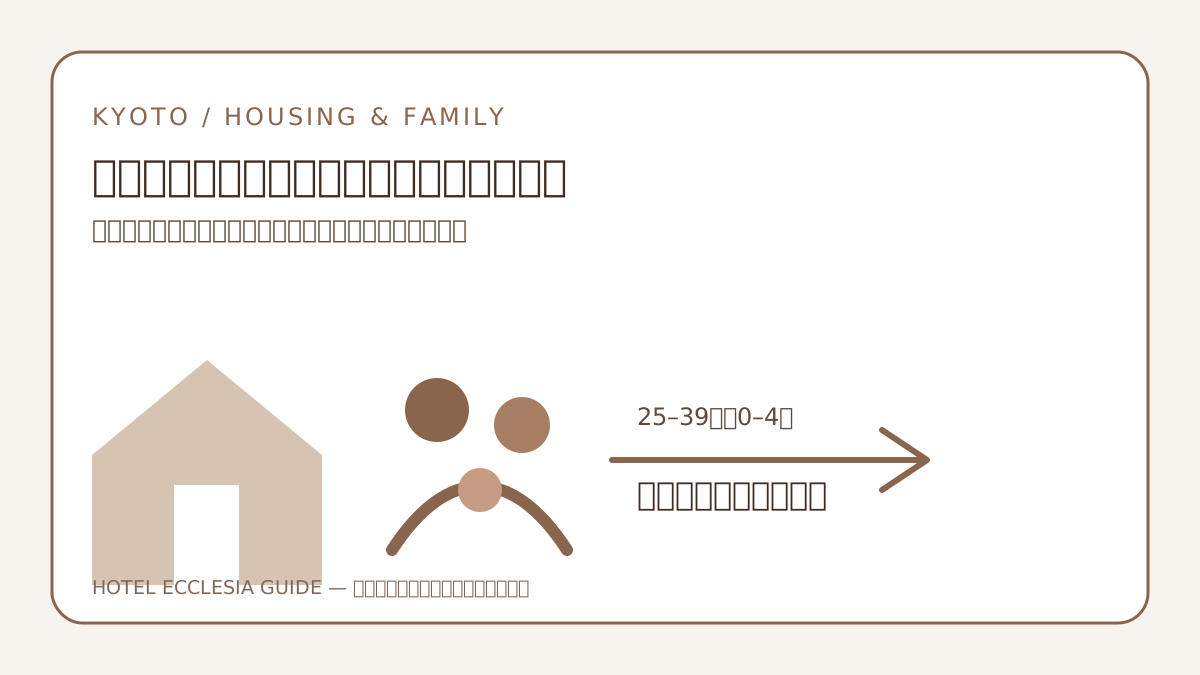
- Kyoto City's own analysis shows net inflow at ages 15–24 but net outflow at ages 25–39, along with children aged 0–4.
- The city says difficulty finding housing that matches family needs is an important factor.
- Kyoto also explicitly cites rising housing prices when explaining policies aimed at keeping homes in residential use.
- Tourism is not a single-cause explanation: land supply, construction costs, housing type, transport, investment and household choices all matter.
A student city that loses people later in life
Kyoto is famous as a university city. Its demographic pattern reflects that: the city reports net inflow among people aged 15–24. But it reports net outflow among those aged 25–39 and among children aged 0–4.
For Japanese residents aged 25–39, major destinations include southern Kyoto Prefecture, Osaka, Shiga and the Tokyo region. Kyoto City says housing, commuting and marriage all play a role, while difficulty securing housing that meets the needs of couples and families appears to have a major influence.
Kyoto City — Population movement analysis ↗
Housing prices are an official policy concern
Kyoto City's FAQ for its tax on non-residential homes goes further. It says that rising housing prices, among other factors, are associated with large outflows of people aged 25–39 and children aged 0–4 to nearby cities.
The policy is designed in part to encourage vacant homes, second homes and other non-primary residences back into circulation and expand housing options for residents.
Kyoto City — FAQ on the tax promoting use of non-residential homes ↗
News reports show what the choice looks like for real households
A 2023 Kansai TV report followed a household that chose to buy outside Kyoto City after looking at local prices. One interviewee said homes in the city were “over ¥50 million.” It is one household, not representative statistics, but it shows how price can enter a family's location decision.
Kansai TV — Housing prices, population outflow and Kyoto's height rules ↗
In 2026, Kansai TV also compared Kyoto with neighboring Shiga and highlighted how station-adjacent housing, lower housing costs and employment can make nearby cities attractive to working families.
Kansai TV — Why family patterns differ between Kyoto and Shiga ↗
Is tourism the reason housing is expensive?
It would be misleading to reduce the problem to tourists or hotels. Kyoto City's official analysis does not do that. Housing markets are shaped by land constraints, construction costs, the size and type of available homes, transport, investment demand, interest rates and many individual choices.
Tourism and accommodation can affect how buildings are used in particular neighborhoods, but there is no basis for treating tourism as the sole explanation for citywide family outflow.
Minpaku rules and housing policy ask a related question
Housing policy and accommodation regulation are separate systems. Still, they meet at one question: in a global tourism city, how do you preserve a place where residents can continue to live?
Kyoto's current review of minpaku and small lodging rules focuses mainly on noise, waste, neighborhood friction and community relations—not on blaming any nationality.
Why Is Kyoto Tightening Minpaku Rules? →
What Kyoto City is doing
Kyoto continues to use vacant municipal housing for homes aimed at younger people and families. In 2026 it again described the outflow of people in the marriage-and-childraising years to nearby cities as a policy challenge.
Its “Kyoto Anshin Sumai” program also supports families with preschool children who buy and renovate existing homes. The 2026–27 program provides ¥1 million as a base amount, with additions up to a total of ¥2 million depending on household and property conditions.
Kyoto City — Housing support for families ↗
Why this matters to visitors too
Kyoto's appeal is not produced only by temples and historic buildings. Neighborhood associations, local shops, schools and community traditions such as Jizobon exist because people actually live here.
If a tourism city becomes increasingly difficult for families to live in, the everyday culture visitors come to experience can change as well. A “livable Kyoto” and a “visit-worthy Kyoto” are not separate goals.
HOTEL ECCLESIA and community-based hospitality
A hotel cannot solve Kyoto's housing market. But an accommodation business is still part of the neighborhood where it operates. HOTEL ECCLESIA aims to be more than a hotel located in Kyoto: we aim to operate as a member of Kyoto's local community, through local relationships, social support and participation in community life.
For us, responsible tourism means considering both the benefits visitors bring and the everyday lives of the people who make Kyoto a living city.
Sources
Population movement and housing prices have multiple causes. We distinguish Kyoto City's official analysis from individual news examples, and we do not treat tourism or accommodation as a single cause.